

AEAJ General assembly and other events on 20-23 May 2026 in Lisbon
AEAJ held the seminar its General Assembly and a serie of related events in Lisbon on 20-23 May 2026. The event was kindly hosted by the Law Faculty of the University of Lisbon and prepared with the precious support of the Associação dos Magistrados da Jurisdição Administrativa e Fiscal de Portugal (AMJAFP), the association of administrative and tax judges of Portugal, and its president, Anabela Russo.
The event was also supported by the Supremo Tribunal administrativo, the Portuguese Supreme administrative court.
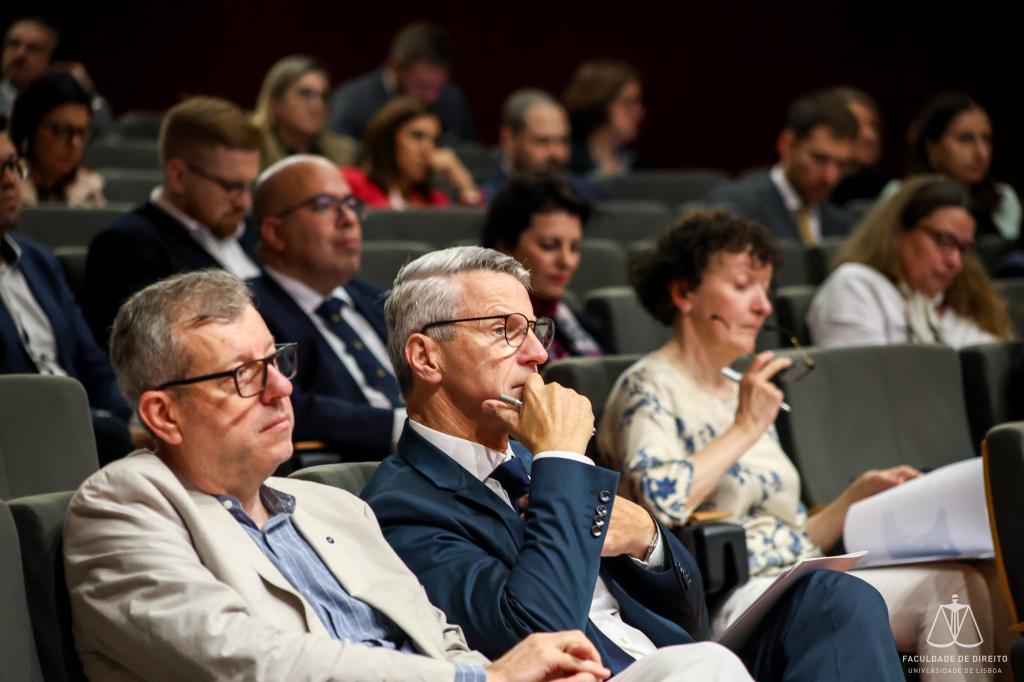 The event welcomed participants and speakers from France, Germany, Austria, Greece, Cyprus, Spain, Poland, Ireland, Sweden, Finland, Lithuania, Hungary, Romania, Slovakia, the Netherlands, Belgium, Luxembourg, Slovenia, Bosnia-Herzegovina, Montenegro, Albania, Kosovo, Ukraine, Moldova, Georgia, Armenia, the United States of America, and of course Portugal.
 It breaked the country diversity record for an AEAJ event with 28 countries present.
 The OSCE Office for Democratic Institutions and Human Rights (ODIHR) organised an introductive side event Wednesday 20 May afternoon, on Emerging Trends and Challenges of Administrative Justice in the Eastern Partnership Countries, a project supported and funded by the European Union.
 ODIHR presented its baseline studies on administrative justice in four countries: Ukraine, Moldova, Armenia, and Georgia, which examine how administrative courts function in practice when adjudicating disputes involving public authorities, with a focus on judicial review of executive restrictions related to freedom of peaceful assembly, adjudication of electoral disputes, and the scope of corrective judicial authority. It introduced a peer-exchange discussion between administrative judges from EAP countries and other AEAJ colleagues.
Konstantine Vardzelashvili, Head of Democratization department at ODIHR, later introduced the General assembly by an honorific speech.
 The annual seminar of the AEAJ Working Group "Independence and Administrative Justice", on the Financial Independence of Administrative Judges, constituted the most substantial part of the event. As it can't rely on judicial autonomy alone, especially due to the budgetary role of Parliament, financial independence is a very specific aspect of judicial independence.
 Speakers presented the framework and the context of financial independence of courts in Europe, adressing its institutional dimension as well as the patterns of budgetary negociations the necessary safeguards, as well as the potential indirect pressure on the administrative judiciary. They mixed transversal European-wide approaches with country-specific experience presented by AEAJ members.
The second part of the seminar was dedicated to the remuneration of judges, an issue arising in many European countries. It concluded by a general discussion on a statement adopted by the Working Group.
 After the General assembly, the Dean of the Faculty of law, Pr. Eduardo Vera-Cruz Pinto, kindly hosted AEAJ members in the faculty reserved rooms and the chamber of the university council, which encompasses the history of the law faculty. AEAJ president Sylvain Mérenne signed the guestbook of the Faculty on behalf of the entire association.
Finally, the event concluded on Saturday by a visit of the iconic Águas Livres Aqueduct (Aqueduct of the Free Waters), a baroque hydraulic infrastructure commissioned by King Dom João V, built between 1731 and 1799. The impressive arches of this national monument are a symbol of Lisbon.
The second part of the visit explored the Mãe d’Água Reservoir, a monumental terminal reservoir with a storage capacity of 5,500 cubic metres of water.
- Latest news
- ✏ Seminar of the WG Asylum and Immigration in Stockholm
- ✏ Seminar of the WG Environment and Planning in Ghent
- ✏ Joint Statement on 10 years of Destruction of Judicial Independence and Democratic Governance in Türkiye
- ✏ AEAJ Lisbon Statement on Judicial Remuneration
- ✏ AEAJ General assembly and other events on 20-23 May 2026 in Lisbon